

Compliance rarely decides it on its own. Both can meet UAE and Saudi rules if the data sits in the right place and can be reached when the authorities ask. In Saudi Arabia, VAT records must be available inside the Kingdom; ZATCA allows a central system outside Saudi Arabia if the records can be accessed in full from inside the Kingdom. This guide compares the two on cost, with a five-year worked example, on control, compliance and security, and ends with a checklist to help you choose.
What is the difference between cloud and on-premises ERP?
Who owns and runs the infrastructure. With cloud ERP, the vendor hosts the system in a data centre and you pay a subscription. With on-premises ERP, you buy licences and run the system on your own servers, in your office or a data centre you rent space in.
| Cloud (software as a service) | On-premises | |
|---|---|---|
| Servers | Vendor's, in a cloud region | Yours, in your building or a rented rack |
| Pricing | Monthly or annual subscription per user | Licence bought upfront, plus annual maintenance |
| Upfront cost | Low: implementation and setup | High: licences, servers, database and setup |
| Upgrades | Applied by the vendor on its schedule | Planned and paid for by you, when you choose |
| IT staff | Not needed for servers, backups or patches | Needed for all three |
| Customisation | Through settings and extensions | Deeper changes possible, at a cost at every upgrade |
| Access | From anywhere with internet, by browser or app | On the office network, or remotely through a VPN |
| Backups and recovery | Vendor's responsibility, set out in the contract | Yours |
| Adding users or companies | Change the subscription | May need more licences and server capacity |
| Leaving | Export your data; the subscription ends | You keep the software, but its support may end |
There is a middle option, sometimes called hosted or private cloud: your own licensed copy, run for you on dedicated servers in a data centre. It offers on-premises control without the server room, at a cost between the two.
How much does cloud ERP cost compared with on-premises? A five-year example
Over five years, cloud usually costs less once you count everything on-premises needs besides the licence: servers, database licences, somewhere to run them, backups, upgrades and someone to look after it all. In this example, cloud comes out about AED 395,000 cheaper.
A Dubai distributor with 50 users compares the two. The figures are illustrative, rounded and exclude VAT; replace them with your own quotes.
| Cost over five years (AED) | Cloud | On-premises |
|---|---|---|
| Software | 1,050,000: AED 350 per user per month | 600,000: licences 300,000, plus maintenance at 20% a year |
| Implementation | 150,000 | 170,000, including server setup |
| Servers, storage and backup hardware | Included | 120,000 |
| Database and server operating system licences | Included | 60,000 |
| Rack space, power and cooling | Included | 120,000 |
| Offsite backup and disaster recovery | Included | 75,000 |
| IT staff time: half a system administrator | Included | 450,000 |
| One major version upgrade | Included | 60,000 |
| Second internet line for resilience | 60,000 | Not needed |
| Total | 1,260,000 | 1,655,000 |
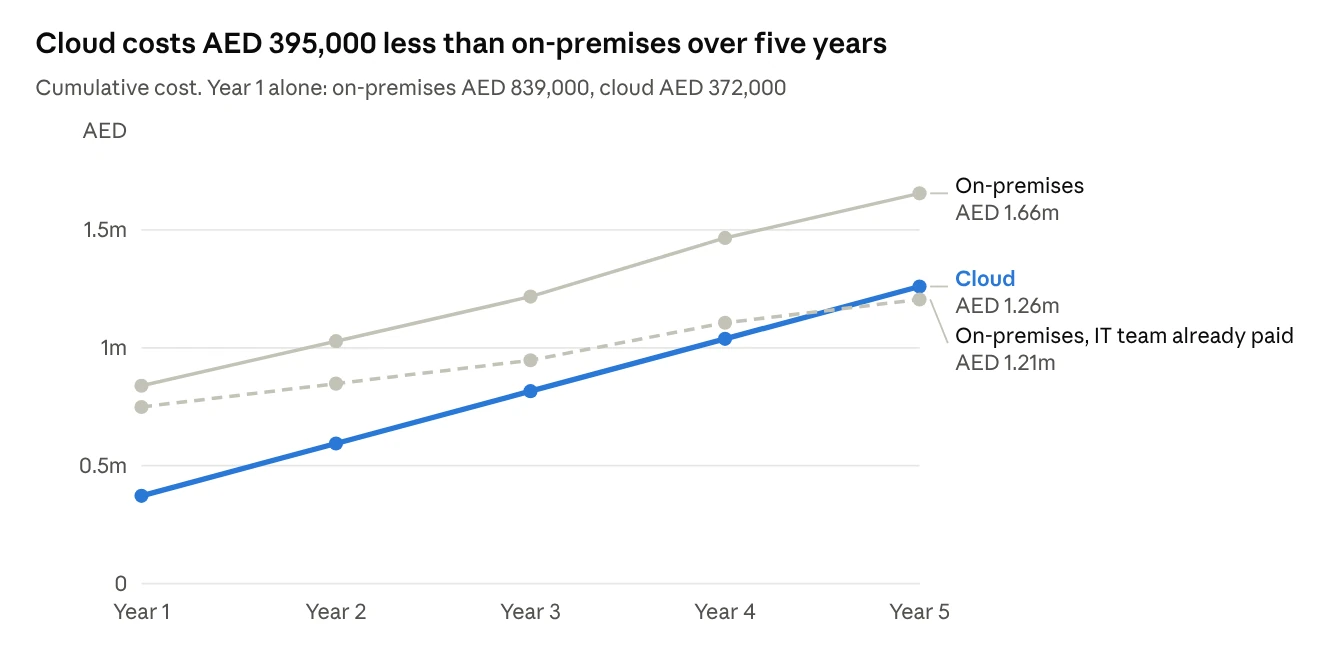
The biggest on-premises cost is not the licence but the people. If you already employ an IT team with spare time, so the AED 450,000 of staff time is not an extra cost, the gap reverses: on-premises comes out about AED 55,000 cheaper over five years. The other difference is cash flow: on-premises puts most of the spending in year one, while cloud spreads it evenly. Annual maintenance of around 20% of the licence price is common for on-premises business software, but check your vendor's rate.
How much control do you give up with cloud ERP?
Less than most buyers expect, but some. You give up control of the servers and the upgrade calendar. You keep control of your data, your processes and who can see what.
| Area | Cloud | On-premises |
|---|---|---|
| Upgrade timing | Vendor's schedule; ask how much notice you get and whether you can test first | Yours; you can stay on an old version, though support for it eventually ends |
| Customisation | Settings, workflows, reports and extensions that survive upgrades | Changes to the core are possible, but each one must be re-tested at every upgrade |
| Local devices | POS terminals, scales and biometric readers connect through a small local connector | Connect directly on the office network |
| Internet outage | The system is unreachable unless there is a backup line or an offline mode | Office keeps working; remote sites may not |
| Data access | Through reports, exports and APIs; direct database access is rare | Full database access |
| Exit | Depends on the export the contract guarantees | You keep the system and the data |
Two points deserve attention in a cloud contract. First, the right to a full export of your data, in a readable format, at any time and at the end of the contract. Second, how updates are announced and tested, so a change never reaches your live system untried.
On the internet question: for a site that cannot trade without the system, such as a shop or warehouse, a second internet line from a different provider costs far less than a lost day of sales.
Can cloud ERP meet UAE and Saudi compliance rules?
Yes, if the data is hosted in the right place and can be reached when needed. The rules are about where data sits and who can reach it, not about who owns the server, so an on-premises system in Dubai faces the same Saudi conditions as a cloud system in a European region.
| Requirement | What it means for cloud | What it means for on-premises |
|---|---|---|
| Saudi VAT records and invoices available inside the Kingdom | A Saudi cloud region, or a central system elsewhere with full access to the records from inside the Kingdom | A server in Saudi Arabia, or full access from inside the Kingdom to a server elsewhere |
| UAE tax records available to the FTA on request, including encryption keys | Confirm you can give access and keys through the vendor | You hold access and keys directly |
| UAE e-invoices | No UAE storage requirement since 1 October 2026 | No change |
| UAE health data, banks' core data and confidential government data | A UAE region is required | A server in the UAE |
| Saudi personal data | Can leave today under transfer safeguards; a draft rule of 6 October 2026 may require storage in the Kingdom | No change if the server is in the Kingdom |
| Record retention: at least 7 years for UAE tax records (15 for real estate); 6 years for Saudi VAT (11 for capital assets, 15 for real estate) | A guaranteed export after you leave | Keep the old system readable |
For a group in both countries, two hosting locations, one in the UAE and one in Saudi Arabia, is the simplest design to defend, though not the only compliant one. Our guide to data residency for cloud ERP in the UAE and Saudi Arabia covers each rule, the cloud regions available and ten questions to ask any vendor.
Is cloud ERP more or less secure than on-premises?
It depends less on where the system runs than on who does the security work. With on-premises, you do all of it. With cloud ERP, the vendor and its cloud provider take on the infrastructure, but some responsibilities always stay with you. Microsoft and AWS both describe this as a shared responsibility model.
| Responsibility | Cloud ERP (software as a service) | On-premises |
|---|---|---|
| Physical security of the data centre | Cloud provider | You, or your rack provider |
| Servers, network and operating system patches | Vendor and cloud provider | You |
| Application updates and security fixes | Vendor | You install them |
| Backups and disaster recovery | Vendor, as the contract sets out | You |
| User accounts, passwords and roles | You | You |
| Who can see what data | You | You |
| Devices your staff use | You | You |
The last three rows are where most breaches start, and they are yours either way. Turn on two-factor sign-in, remove leavers' accounts the day they leave, and review roles twice a year.
When comparing cloud vendors, ask for their ISO/IEC 27001 certificate and check what it covers: the application and the hosting, not just the vendor's office. Ask also how quickly security fixes are applied, and where backups are kept.
Which should you choose: cloud or on-premises?
Start from cloud and look for a reason not to. Tick the statements that are true for you.
Cloud is likely the better fit if:
On-premises is worth considering if:
If most of your ticks are in the first list, choose cloud. If you have one strong tick in the second list, such as a contract that requires on-premises data, that can decide it on its own. If the only reason is control of the upgrade timetable, a private cloud or a cloud contract with a test window may give you enough of it.
What does HYP see when companies make this choice?
Most companies that ask HYP about on-premises are really asking about control: of their data, of when things change, and of what happens if they leave. Once those are written into the contract, most of them choose cloud.
The companies that stay on-premises usually have a specific reason, such as a government contract that requires local hosting or a large site with poor connectivity. The ones that regret their choice tend to be on-premises users who planned for the servers but not for the person to look after them, and fall several versions behind.
HYP ERP is a cloud ERP, and HYP is ISO/IEC 27001 certified. See our Security & Trust page for how we host, protect and back up customer data.
Sources
- ZATCA: Guideline for Tax Invoicing and Records, May 2026 (where records are kept)
- UAE Ministry of Finance: Cabinet Decision No. 74 of 2023 on the Executive Regulations of the Tax Procedures Law (record retention)
- UAE Ministry of Finance: Federal Decree-Law No. 47 of 2022 on Corporate Tax
- Microsoft: Shared responsibility in the cloud
- AWS: Shared responsibility model
- Microsoft: SQL Server 2022 pricing
- Microsoft: Windows Server pricing
The UAE e-invoice storage change, the UAE health data rule and the Saudi draft personal data rule are sourced in our data residency guide.