










Article
UAE Corporate Tax: The Records the FTA Will Ask For First
What UAE corporate tax records to keep for 7 years, who needs audited accounts, transfer pricing thresholds, and the first documents the FTA asks for.
Corporate Tax
This page helps UAE businesses keep the records Corporate Tax requires and prepare for year-end review. HYP ERP keeps the ledger, expenses, fixed assets and group records connected and closed, so your tax advisers start from books they can trust.

HYP ERP corporate tax readiness is the accounting foundation HYP ERP provides for UAE Corporate Tax preparation: general ledger, revenue and expense records, fixed assets and depreciation, intercompany records and financial reports that finance teams and tax advisers use when reviewing taxable income and related obligations.
Taxable income can differ from accounting profit because of adjustments and reliefs under the law, so advisers need books they can trust before they begin. When income, expenses and assets sit in different applications, year-end becomes a reconstruction exercise. HYP ERP keeps those records connected and closed, ready for the tax analysis.
HYP ERP
Updated 28 October 2026
| What the rule requires | How HYP ERP handles it |
|---|---|
| Keep the records that support your return for at least 7 years after the tax period. | Holds the chart of accounts, journals and source documents in one ledger, closed period by period. |
| Start taxable income from accounting profit in standalone financial statements, then adjust. | Provides accounting profit and statements; your finance team and advisers decide adjustments, exemptions and reliefs. |
| Record asset additions, disposals and depreciation; book depreciation is generally the tax deduction. | Maintains fixed asset records, depreciation, disposals and their accounting entries, ready for review. |
| Price related-party deals at arm's length; provide transfer pricing documents within 30 days of request. | Posts intercompany journals and maps accounts, so each entity's records are readable on their own. |
| Expect the FTA to compare revenue in your VAT returns with revenue in the accounts. | Keeps VAT records in the same ledger, so revenue can be reconciled across both taxes. |
| Prepare audited statements above AED 50 million revenue or as a Qualifying Free Zone Person. | Produces financial statements, account inquiries and management reports from closed periods. |
| Tax Groups need audited special-purpose financial statements for the group. | Supports multi-company accounting and consolidation, showing each entity separately and the combined position. |
Manage the chart of accounts, journal vouchers and financial entries, then close each period so year-end figures are settled before tax review.
Bring receivables, payables, sales, purchasing and expense documents into the ledger, so income and cost classifications can be reviewed at their source.
Maintain fixed asset records, depreciation, disposals and their accounting entries, available for review even where tax treatment differs from the financial books.
Post intercompany journals, map accounts and analyze group finances, so each entity is understood on its own before group considerations are assessed.
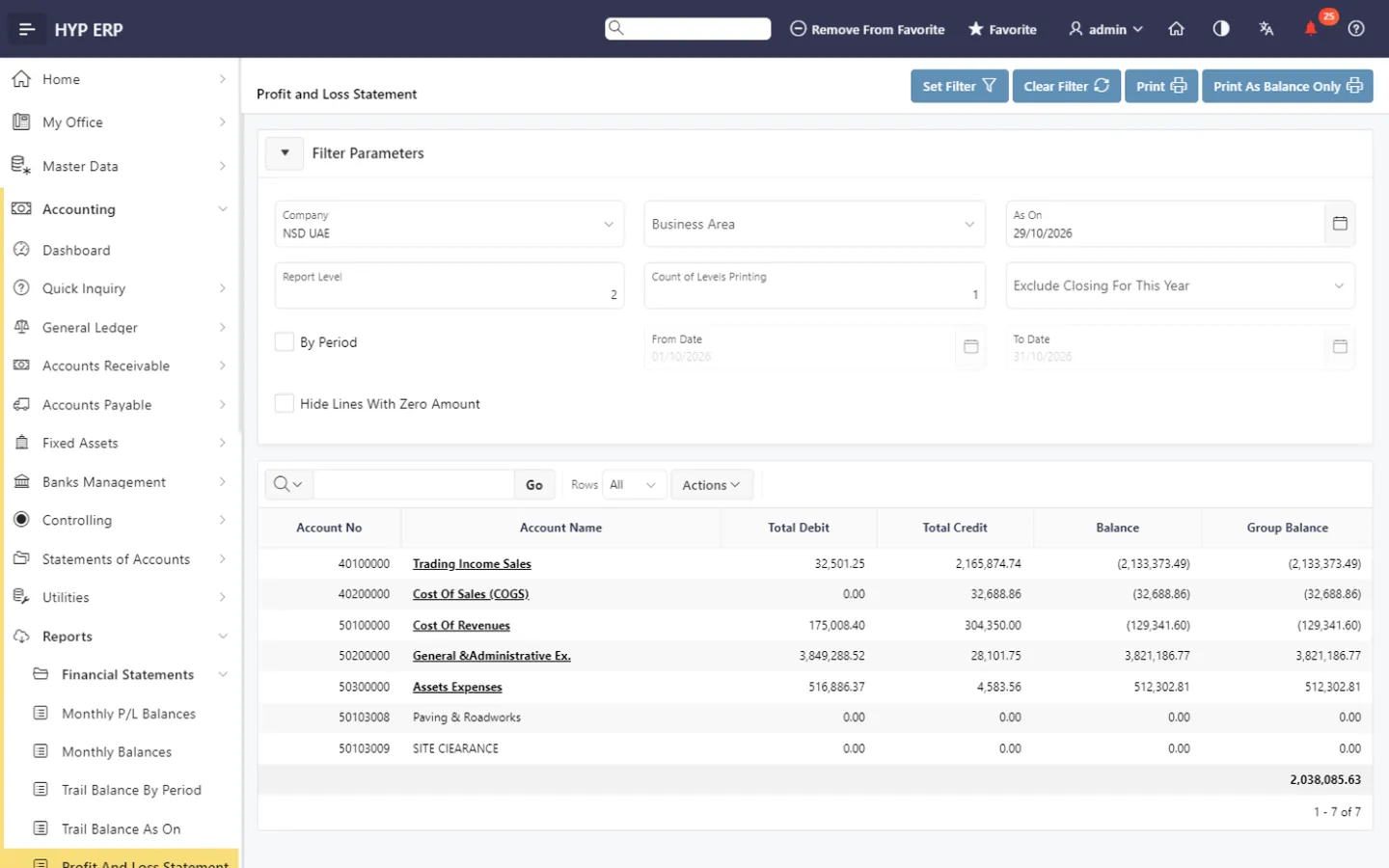
Produce financial statements, account inquiries and management reports, and monitor budgets and controlling records through the year.
Maintain income, expenses, transactions and company records.
Complete the period-end review and accounting close.
Prepare statements and supporting detail for the tax assessment.
Tax professionals apply the statutory adjustments and filing process, outside or alongside approved specialist tools.
Benefits
Books and period-end statements ready for tax analysis, without reconstructing income and expense records from several applications or chasing year-end reconciliation delays.
Supporting income, expense and fixed asset detail to review before deciding adjustments, instead of working from incomplete asset registers.
Company-level accounts that stay readable across multiple entities, with intercompany records that support group-level financial analysis.
From the blog
Article
What UAE corporate tax records to keep for 7 years, who needs audited accounts, transfer pricing thresholds, and the first documents the FTA asks for.
Read the articleArticle
How UAE businesses depreciate fixed assets under IAS 16, and how Corporate Tax treats depreciation, disposals, revaluations and investment property.
Read the articleArticle
A five-day month-end close checklist for UAE and Saudi finance teams, with VAT and e-invoicing steps, a worked bank reconciliation and evidence pack.
Read the articleNo. HYP ERP provides the accounting profit, ledger and asset records; tax-specific adjustments, exemptions and reliefs are determined by your finance team and tax advisers when they convert those records into taxable income.
No. HYP ERP keeps the books and reports used to prepare corporate tax information; your business and its advisers complete the return and submit it through the applicable filing process.
Yes. HYP ERP fixed asset functions hold asset records, depreciation, disposals and the related accounting entries, so finance teams and tax advisers can review asset information during corporate tax preparation.
Yes. HYP ERP supports multi-company accounting, intercompany journals, account mapping and consolidation, so groups can review each entity's corporate tax records separately and also see the combined position.
See how HYP ERP moves from period close to the statements your tax advisers review.