

This guide gives every phase and date, what is in and out of scope, the penalties, and a month-by-month plan for SMEs. It includes the rule changes the Ministry of Finance announced on 19 October 2026, which most guides have not caught up with yet.
What is UAE e-invoicing?
UAE e-invoicing is a national system where invoices travel as structured XML data between accredited service providers, and each invoice's tax data is reported to the Federal Tax Authority (FTA) as it is sent. A PDF, a scanned invoice or an emailed Word file is not an e-invoice.
The Ministry of Finance calls the model Decentralised Continuous Transaction Control and Exchange (DCTCE). It runs on the Peppol network, and invoices follow PINT AE, the UAE version of Peppol's international invoice format. Unlike Saudi Arabia's ZATCA clearance model, the FTA does not approve each invoice before the buyer receives it.
Every business in scope works through its own ASP, both to send and to receive. Your accounting system cannot connect to the FTA directly.
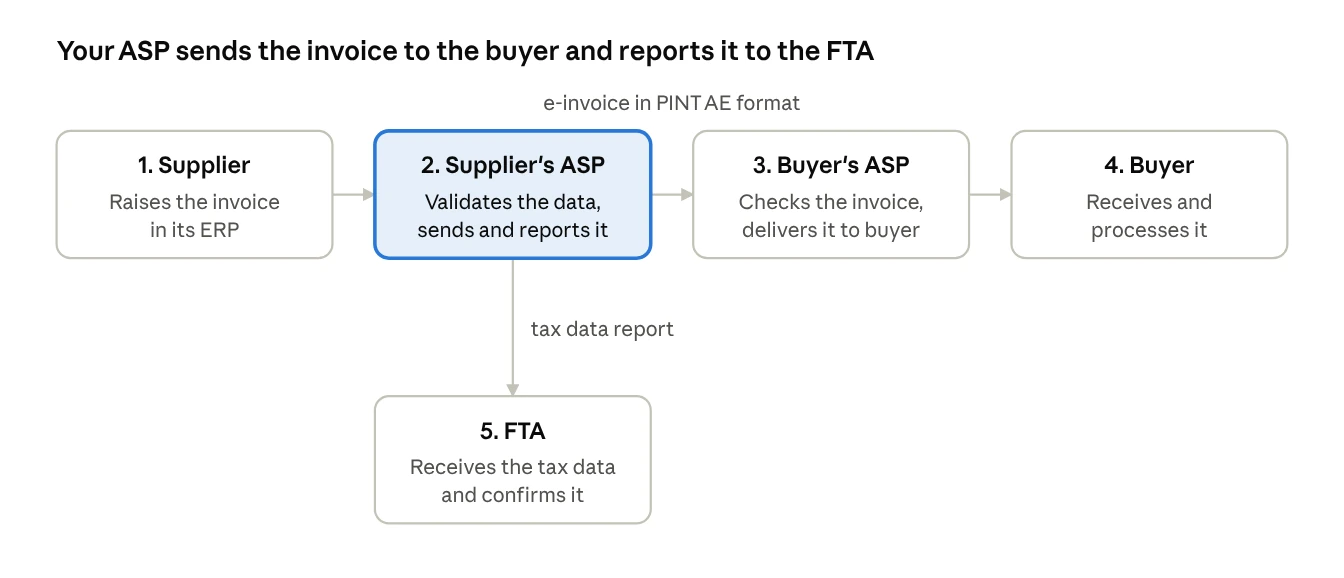
The supplier's ASP does the work that matters for compliance: it checks the invoice data, passes the invoice to the buyer's ASP and reports the tax data to the FTA.
When is the UAE e-invoicing deadline for each phase?
The deadline depends on your revenue: SMEs below AED 50 million appoint an ASP by 31 March 2027 and go live on 1 July 2027.
| Phase | Who | Appoint an ASP by | E-invoicing mandatory from |
|---|---|---|---|
| Phase 1 | Revenue of AED 50 million or more | 30 October 2026 (moved from 31 July 2026) | 1 January 2027 |
| Phase 2 | Revenue below AED 50 million | 31 March 2027 | 1 July 2027 |
| Government | Government entities | 31 March 2027 | 1 October 2027 |
- Revenue means gross income in your most recent accounting period, based on your financial statements. Check each legal entity in a group separately.
- Pilot and voluntary use: a pilot with a Ministry-selected group of taxpayers started on 1 July 2026, and any business may join voluntarily from that date. Penalties apply only from your mandatory date.
- Only one date has moved. Ministerial Decision No. 66 of 2026 extended the Phase 1 ASP deadline; the Ministry confirmed on 10 May 2026 that go-live dates are unchanged. The SME dates have not moved, so plan for 31 March 2027.
The dates come from Ministerial Decision No. 244 of 2025, as amended. See the Sources section for the official texts.
Which businesses and transactions are in scope?
Any business that invoices another business or a government entity in the UAE is in scope, whether or not it is VAT registered. The obligation runs both ways: you must issue e-invoices and e-credit notes, and you must be able to receive them.
| Transaction | Must it be an e-invoice? |
|---|---|
| Sale to a UAE company (B2B) | Yes |
| Sale to a government entity (B2G) | Yes |
| Credit note for a cancelled sale, price reduction, refund or error | Yes, as an e-credit note |
| Tax invoice issued for an export | Yes |
| Sale to a member of your own VAT group | No, excluded for 24 months from 1 January 2027 |
| Retail or restaurant sale to a consumer (B2C) | No, until the Minister sets a date |
| VAT-exempt or zero-rated financial services | No |
| International airline passenger tickets | No |
A business that sells mostly to consumers is still in scope for its business invoices. A restaurant that invoices corporate catering clients, or a retailer that bills trade accounts, must issue those invoices as e-invoices.
The VAT group exclusion is now confirmed in law. Ministerial Decision No. 197 of 2026, announced on 19 October 2026 and effective from 1 October 2026, treats transactions between members of the same tax group as excluded until 31 December 2028.
What must SMEs do before 31 March 2027?
SMEs have about five months to confirm their phase, clean their data and sign with an ASP. Ramadan is expected to run from early February to early March 2027, so aim to finish the ASP decision by the end of January.
- November 2026: confirm your phase. Take revenue from your latest financial statements for each legal entity and compare it with AED 50 million.
- November 2026: find every place an invoice is made. List your ERP, POS terminals, branch systems, project billing, and any Word or Excel templates. Every B2B invoice must come out of a system that can send it to your ASP.
- December 2026: clean your customer master data. Every B2B customer needs a correct legal name, address and Tax Registration Number. Your own Peppol ID will be 0235 followed by your 10-digit Tax Identification Number.
- December 2026: check your ERP's invoice data. Confirm it can produce the Ministry's mandatory fields, VAT per line, credit notes linked to the original invoice, and invoices for advance payments.
- January 2027: shortlist and appoint an ASP. Choose from the Ministry's accredited list, sign the contract and onboard through the FTA's EmaraTax portal. See our guide How to Choose an Accredited Service Provider for UAE E-Invoicing.
- By 31 March 2027: appointment complete. Keep the signed agreement and your Peppol ID on file.
- April to June 2027: test and train. Test invoices and credit notes end to end, including a rejected invoice, and train the staff who raise invoices.
- 1 July 2027: go live. From this date every in-scope invoice and credit note goes through your ASP.
Your Phase 1 suppliers start sending e-invoices on 1 January 2027, with a normal tax invoice alongside until you are onboarded, so accounts payable will see both formats for six months.
Where do SMEs usually get stuck?
In our e-invoicing readiness work with HYP ERP customers, the ASP contract is rarely the hard part. The delays come from invoices and data that sit outside the main system.
| What we see | Why it matters | What to do |
|---|---|---|
| One-off invoices typed in Word or Excel | They cannot reach an ASP | Raise every B2B invoice in the ERP, even for one-off services |
| Customer records with no TRN | The e-invoice fails validation | Collect TRNs now, before go-live |
| Credit notes raised as negative invoices | An e-credit note must reference the original invoice | Issue proper credit notes from the original invoice |
| No invoice when an advance is received | The Ministry's guidelines require a tax invoice at the advance | Invoice the advance, then bill only the balance |
| Construction retentions billed at full value | The guidelines allow the invoice to show only the amount payable now | You may invoice the net amount, then invoice the retention on release |
| Branches or POS issuing their own B2B invoices | Each source needs a route to the ASP | Route branch and POS invoices through the central ERP |
The advance and retention rules come from version 1.1 of the Ministry's Electronic Invoicing Guidelines, published on 1 June 2026.
What are the penalties for missing the deadline?
Missing the ASP or go-live deadline costs AED 5,000 for each month, or part of a month, of delay. The penalties are set by Cabinet Decision No. 106 of 2025.
| Violation | Penalty |
|---|---|
| Not implementing the system or not appointing an ASP on time | AED 5,000 per month or part of a month |
| Not issuing and sending an e-invoice | AED 100 per invoice, up to AED 5,000 per calendar month |
| Not issuing and sending an e-credit note | AED 100 per credit note, up to AED 5,000 per calendar month |
| Not telling your ASP about changes to your registered data | AED 1,000 per day of delay |
Worked example. An SME appoints its ASP on 15 May 2027 instead of 31 March 2027. The delay covers April in full and part of May, so the penalty is 2 × AED 5,000 = AED 10,000, before any per-invoice fines once 1 July arrives.
The Cabinet Decision also fined late notice of a system failure. Ministerial Decision No. 197 of 2026 repealed that notice requirement from 1 October 2026.
Sources
- Ministry of Finance: amendments to the e-invoicing regulations, 19 October 2026
- WAM: Ministry of Finance extends the Phase 1 ASP deadline, 10 May 2026
- Ministerial Decision No. 243 of 2025 on the Electronic Invoicing System
- Ministerial Decision No. 244 of 2025 on implementation timelines
- Ministerial Decision No. 66 of 2026 amending Decision No. 244
- Cabinet Decision No. 106 of 2025 on e-invoicing penalties
- UAE Electronic Invoicing Guidelines, version 1.1, 1 June 2026
- KPMG: implementation of the e-invoicing system in the UAE