
The rules matter too. Saudi Arabia's 2025 municipal requirements define cloud kitchens and link commercial licences to each food activity in a complex, while in the UAE we found no dedicated cloud kitchen licence in official sources. This guide covers brand selection, licensing, a worked profit-by-brand example, stock, order flow and VAT.
Which brands work well together in one kitchen?
Brands work together when they draw on the same ingredients and stations but sell to different cravings. A burger brand and a rice-bowl brand can share chicken, sauces, a grill and a fryer; a sushi brand would need its own stock, skills and cold chain.
Test each new brand against four questions:
| Question | Good sign | Warning sign |
|---|---|---|
| How many of its ingredients are already in stock? | Most of them | More than a handful of new items |
| Which stations does it use? | Stations with spare capacity at its peak hours | The same station as your busiest brand at the same time |
| Does it travel well? | Holds texture for 30 minutes in a box | Fried or delicate items that arrive soggy |
| Does it compete with your own brands? | Different cuisine or meal occasion | Customers choose between two of your brands |
The best addition often uses an underused station at a different time of day: a breakfast brand on the grill before lunch, or a dessert brand from the cold section late at night. Peak-hour clashes, not ingredient lists, are what usually limit the number of brands a kitchen can run.
What licences and food rules apply to cloud kitchens?
Saudi Arabia has specific municipal rules for cloud kitchens; the UAE treats them under general food establishment and trade licensing. In both countries, check with the licensing authority how many brands one licence covers before you launch a new one.
| Topic | UAE | Saudi Arabia |
|---|---|---|
| Specific cloud kitchen rules | None found in official Dubai or Abu Dhabi sources; a delivery-only restaurant activity is commonly used | Defined in the Ministry of Municipalities and Housing Restaurant Requirements (2025) |
| Licence per brand | Several brands under one licence is common practice, but not a published rule | Licences are tied to each food activity in a cloud kitchen complex; whether that means one per brand is not stated, so confirm with Balady |
| Site rules | Food establishment approval from the municipality | Commercial street; complex of at least 50 m² plus 16 m² per kitchen; pickup area of at least 6 m² (24 m² for a complex); courier traffic managed |
| Food safety staff | Dubai Municipality requires a certified Person in Charge (PIC) | Approval from the food supervisory authority is part of licensing |
| Menu information | Check current Dubai calorie labelling rules | Calories on every item, plus salt and caffeine icons from 1 July 2025, on menus and delivery apps |
In free zones, rules differ again: Meydan Free Zone, for example, lists a "take-out eating places" activity that covers cloud and dark kitchens. Licensing details change, so confirm them with the authority for your location.
How do you know which brand makes money? A worked example
Calculate each brand's contribution from its own sales, food cost and app deductions, then share the kitchen's common costs between brands. How you share them can change the answer, as this Dubai kitchen's month shows. Figures are illustrative, in AED, before VAT. Our guide to delivery app commissions breaks down the app deductions in detail.
| Burgers | Rice bowls | Desserts | Total | |
|---|---|---|---|---|
| Net sales | 120,000 | 80,000 | 40,000 | 240,000 |
| Orders | 2,400 | 2,000 | 1,600 | 6,000 |
| Food cost | (38,400) at 32% | (22,400) at 28% | (10,000) at 25% | (70,800) |
| App commission and packaging, 25% combined (for example, a 22% commission plus 3% packaging) | (30,000) | (20,000) | (10,000) | (60,000) |
| Brand contribution | 51,600 | 37,600 | 20,000 | 109,200 |
| Shared labour, rent and utilities, by orders (AED 14 per order) | (33,600) | (28,000) | (22,400) | (84,000) |
| Profit by brand | 18,000 | 9,600 | (2,400) | 25,200 |
Shared costs here are split by number of orders, because each order takes about the same packing and dispatch effort. On that basis, desserts lose money: many small orders each carry AED 14 of shared cost.
Split the same AED 84,000 by sales instead and desserts carry only AED 14,000, showing a profit of AED 6,000. Neither method is wrong, but choose one that reflects how the kitchen really spends its time, and use it every month. Here, the answer points to a minimum order value or a bundle for the dessert brand, not to closing it.
How should stock and recipes work across brands?
Keep one stock of ingredients for the whole kitchen and one recipe for each brand's dishes. Stock is counted by ingredient, not by brand; recipes tell you how much of each ingredient each brand used.
- One ingredient list. The same chicken thigh, buns and garlic sauce appear once in stock, whichever brand uses them.
- Recipes per dish, per brand. Each dish has a costed recipe, including batch recipes for shared sauces and marinades.
- Usage by brand from sales. The POS multiplies each brand's dishes sold by their recipes, giving each brand's theoretical food cost.
- One stock count. A weekly count of the main ingredients compares actual use with the total theoretical use across all brands.
- Par levels set for the whole kitchen. Reorder points reflect combined demand, which smooths out one brand's quiet day against another's busy one.
This is where shared ingredients pay off. Combined demand means larger orders, better supplier prices and less waste, because a slow day for one brand is covered by another. The risk is that waste becomes nobody's problem, so log waste by ingredient and investigate any item whose actual use runs ahead of theoretical use.
How do orders from several apps reach one kitchen?
The kitchen should see orders by station, not by app or brand. Orders from every app flow into the POS, the POS splits each order into station tickets, and packing reassembles them under the right brand.
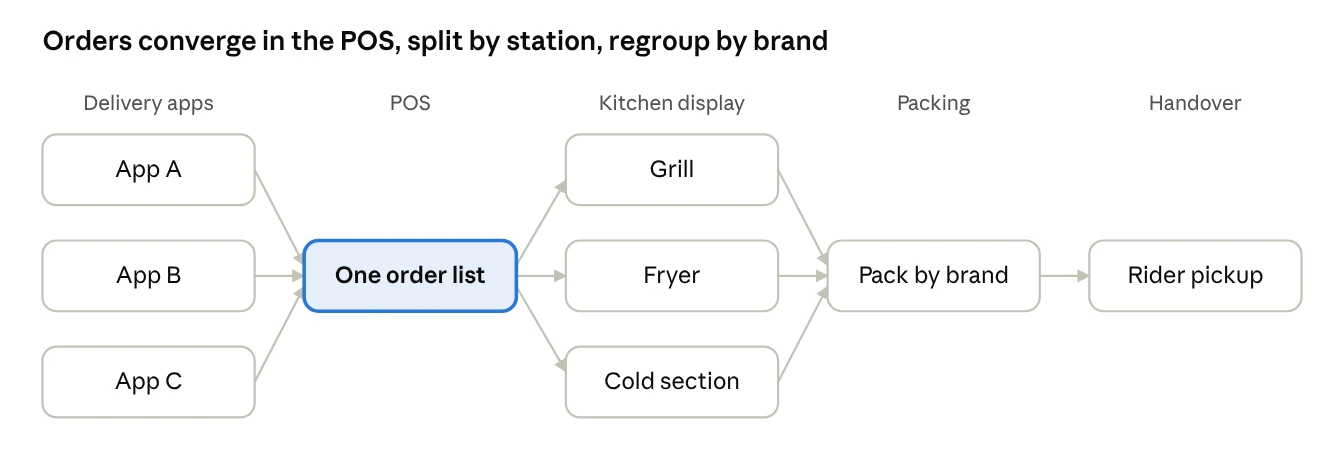
Three settings make the flow work:
- One tablet-free order stream. Integrate each app with the POS so cooks never re-key orders from separate tablets.
- Station routing. The kitchen display sends each item to its station, such as grill, fryer or cold section, whatever the brand.
- Brand packing. Packing checks every item, packs in the brand's own packaging and hands over to the right rider with the right order number.
Track prep time and on-time handover by brand and by station. A brand whose orders are often late usually points to a station that is overloaded at that brand's peak.
How do VAT and e-invoicing work with several brands?
VAT registration belongs to the legal entity, not the brand. Three brands run by one company share one VAT registration, and all their sales go into one VAT return, at 5% in the UAE and 15% in Saudi Arabia. In Saudi Arabia, each simplified invoice must also be reported to ZATCA within 24 hours.
In practice, keep brand as a reporting dimension in the POS and ledger, so you can see sales and costs by brand, while VAT is reported once for the entity. In Saudi Arabia, plan device onboarding for every POS or tablet that issues invoices, however many brands it serves. If each brand sits in a separate company, each company needs its own registration and return.
Where do cloud kitchens lose track of their numbers?
In HYP's work with multi-brand kitchens, operations usually run well before reporting does. The kitchen is busy and on time, but nobody can say which brand pays for itself.
| What we see | Effect | The fix |
|---|---|---|
| One POS menu for all brands, without brand tags | Sales cannot be split by brand | Tag every dish with its brand |
| Separate stock per brand | Duplicate ordering and waste | One ingredient stock, recipes per brand |
| App payouts booked as one figure | Commissions by brand are invisible | Record each app's sales and commissions by brand |
| Shared costs never allocated | Every brand looks profitable | Agree an allocation basis and apply it monthly |
| New brands added without a station check | Peak-hour delays across all brands | Test station load before launch |
A monthly profit-by-brand report, like the worked example above, is usually enough to decide which brand to grow, fix or retire.
Sources
- Saudi Ministry of Municipalities and Housing: Restaurant Requirements, 2025
- Saudi Ministry of Municipalities and Housing: unified food establishment requirements, 10 August 2025
- Dubai Municipality: mandatory Person in Charge in food establishments, 7 June 2020
- Meydan Free Zone: take-out eating places activity
- SFDA: calorie information on menus, 5 August 2018
- Gulf News: Saudi menu rules on salt, caffeine and calories, 2 July 2025
- Federal Tax Authority: VAT registration
- ZATCA: E-Invoicing Detailed Guideline