

You can build the first version in an afternoon from data you already have. This guide explains why 13 weeks works, the six steps to build it, where each line comes from, a worked example for a Dubai distributor, and the weekly routine that keeps it accurate.
What is a 13-week cash flow forecast, and why 13 weeks?
It is a rolling, week-by-week view of cash in and cash out for the next quarter. Each week you drop the week just ended, add a new week 13, and replace estimates with what actually happened.
Thirteen weeks is a quarter, and the length is a balance between two needs:
- Weekly, not monthly. Most cash problems happen inside a month. Salaries, rent, a VAT payment and a large supplier invoice can all fall in the same week, while customer receipts arrive in another. A monthly forecast averages that away.
- Long enough to act. Thirteen weeks gives you time to chase a large customer, agree new terms with a supplier, delay a purchase or arrange bank finance before the shortfall arrives.
- Short enough to be accurate. Most of the cash in the next quarter is already known: invoices you have issued, bills you have received, salaries and tax dates.
It is different from a budget. A budget plans profit for the year; the 13-week forecast tracks cash, which can run out in a profitable business when customers pay late.
How do you build a 13-week cash flow forecast?
In six steps, with one column per week and one row per type of receipt or payment.
- Start from a reconciled bank balance. Add up today's balances across all your bank accounts, after reconciling them. A forecast built on a wrong opening balance is wrong in every week.
- Forecast receipts from open invoices. Take each unpaid customer invoice and place it in the week you expect the money, based on how that customer actually pays, not the due date.
- Add receipts from sales not yet invoiced. Use your sales pipeline or last quarter's weekly average for cash sales and new orders, and be conservative.
- Forecast payments. Payroll on its fixed date, rent and other fixed costs, supplier invoices on their agreed due dates, loan repayments, and tax payments.
- Calculate the closing balance each week. Opening balance, plus receipts, minus payments. Compare it with a minimum cash buffer: the lowest balance you are comfortable with, often a month of fixed costs.
- Compare forecast with actual every week. Note the difference for each line, find the reason, and adjust your assumptions.
Keep it to 10 to 15 lines. More detail adds work without making the forecast more accurate.
Where does each line of the forecast come from?
Most lines come straight from your accounting system. The skill is in the timing: when the cash actually moves, not when the invoice is due.
| Line | Source | Timing rule |
|---|---|---|
| Receipts from open invoices | Receivables ageing | The customer's usual days to pay, not the due date |
| Receipts from new sales | Sales orders and pipeline | Order date plus the customer's usual days to pay |
| Cash and card sales | Last quarter's weekly average | Card settlements one to three days after the sale |
| Supplier payments | Payables ageing and purchase orders | Agreed due date; imports when the letter of credit or transfer falls due |
| Payroll | Payroll register | Fixed date each month |
| Rent and fixed costs | Contracts | Due date; many Gulf leases are paid by post-dated cheques |
| UAE VAT | VAT return | Within 28 days after the end of each tax period |
| Saudi VAT | VAT return | By the end of the month after the tax period |
| UAE corporate tax | Tax return | Within nine months after the end of the tax period |
| Loan repayments | Loan schedule | Fixed dates |
| Owner drawings or dividends | Board or owner decision | Planned date |
Two lines catch people out. VAT is collected from customers over a quarter but paid in one week, so it is a large single outflow. Post-dated cheques you have issued are cash that will leave on a known date, so list them by their cheque date.
What does a 13-week forecast look like? A worked example
A Dubai building supplies distributor starts its first forecast with AED 600,000 in the bank and sets a minimum buffer of AED 250,000, about one month of fixed costs. The first draft shows the balance dropping well below the buffer in weeks 7 and 8.
The cause is three large payments landing together, while receipts stay normal:
| Week | Payment | AED |
|---|---|---|
| 7 | Quarterly VAT payment | 140,000 |
| 7 | Supplier payment for an import shipment | 250,000 |
| 7 | Other suppliers and costs | 80,000 |
| 8 | Salaries | 180,000 |
| 8 | Other suppliers and costs | 200,000 |
With seven weeks' notice, finance takes two actions. It chases two overdue invoices totalling AED 120,000, which the draft had left out as doubtful, and collects them in week 6. It agrees with the import supplier to pay AED 100,000 of the shipment in week 10 instead of week 7.
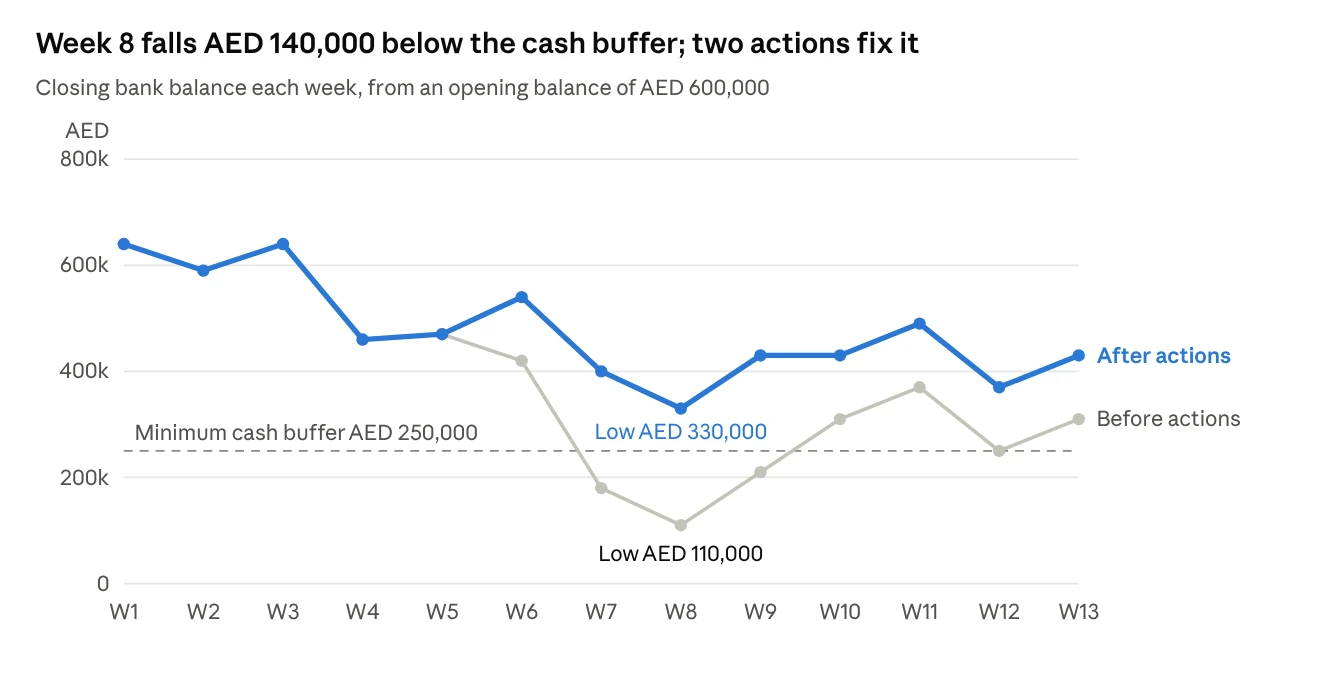
Neither action needed a bank loan, and both were only possible because the gap was seen weeks in advance. A monthly forecast would have netted the AED 850,000 paid out in weeks 7 and 8 against the AED 1,060,000 received across the same month (weeks 5 to 8) and shown one month-end figure, without showing which week the cash runs short or which payment to move.
How do you keep the forecast accurate week after week?
With a fixed 30-minute routine on the same day each week, usually Monday morning after the bank reconciliation.
Track accuracy with one number: the difference between forecast and actual closing balance, four weeks ahead. If it is regularly more than 10% out, the timing assumptions for receipts usually need fixing. Customers who "always pay in 60 days" often pay in 75.
What does HYP see when SMEs start forecasting cash?
The first forecast usually surprises the owner. Not because the business is short of cash overall, but because of one or two weeks where salaries, VAT and a big supplier payment meet. Those weeks were always there; the spreadsheet of monthly totals hid them.
The forecasts that last are the ones that take under an hour a week. That means pulling receivables, payables and payroll straight from the accounting system instead of retyping them, and starting from a bank balance that has already been reconciled. Our guide to the bank reconciliation process covers that first step.
The forecast is also only as good as your collections. If receipts keep slipping, our guide to a customer credit limit policy and collections routine shows how to bring them back on time. See how HYP gives finance a live view of cash, receivables and payables on our Banking, Fixed Assets & Cash Visibility page.
Sources
- UAE Ministry of Finance: Federal Decree-Law No. 47 of 2022 on Corporate Tax (return and payment within nine months)
- Gulf News: FTA reminds businesses that VAT returns and payments are due within 28 days of the end of the tax period
- Bloomberg Tax: ZATCA announces the VAT return filing deadline for Q3 2025