
That formula is the starting point, not the answer. This guide works through all five steps with real numbers: costing a recipe with yields, choosing a target, adding VAT for the UAE and Saudi Arabia, checking contribution, and adjusting prices for delivery apps.
Step 1: how do you calculate the cost of a dish?
Cost each ingredient at the amount you actually serve, after trimming and cooking losses. The key adjustment is yield: if you buy a kilo of chicken and serve 750 grams after trimming and cooking, each served gram costs a third more than the purchase price suggests.
Effective cost per kg = purchase price per kg ÷ yield %
Worked example: a grilled chicken rice bowl in Dubai. Prices are illustrative and exclude VAT.
| Ingredient | Purchase price | Yield | Effective cost | Portion | Portion cost (AED) |
|---|---|---|---|---|---|
| Boneless chicken thigh | AED 24.00/kg | 75% | AED 32.00/kg | 150 g cooked | 4.80 |
| Basmati rice | AED 6.00/kg | 100% (weighed raw) | AED 6.00/kg | 80 g raw | 0.48 |
| Garlic sauce (batch recipe) | AED 10.00/kg | 100% | AED 10.00/kg | 40 g | 0.40 |
| Salad: lettuce, tomato, cucumber | AED 8.00/kg | 85% | AED 9.41/kg | 80 g | 0.75 |
| Pickles and bread | 1 serving | 0.60 | |||
| Spices and oil | 1 serving | 0.35 | |||
| Plate cost | 7.38 |
Three habits keep recipe costs accurate. Cost sauces and marinades as their own batch recipes, then use them as ingredients. Weigh yields yourself rather than using a supplier's figure. And update purchase prices whenever a supplier invoice changes, so plate costs move with the market.
Step 2: what target food cost % should you use?
Most restaurants target a food cost of about 28% to 35% of the price before VAT. A single target for the whole menu is a reasonable start, but different kinds of dish carry different margins.
| Type of item | Typical target | Why |
|---|---|---|
| Hot drinks, juices, soft drinks | Lower than the menu average | Low ingredient cost; customers expect a markup |
| Pasta, rice and grain dishes | Around the menu average or lower | Cheap base ingredients |
| Chicken and vegetarian mains | Around 30% | The menu's middle |
| Premium meat and seafood | Higher, often 35% to 40% | Customers resist a full markup on expensive cuts |
The overall menu still has to land within your prime cost goal. Our guide to restaurant prime cost shows how food cost and labour combine, and what range to aim for.
For the chicken bowl, we use 30%.
Steps 3 and 4: how do you turn plate cost into a menu price?
Divide the plate cost by the target food cost to get the price before VAT, then add VAT, because menu prices must be shown including VAT in both the UAE and Saudi Arabia.
Price before VAT = plate cost ÷ target food cost %
Menu price = price before VAT × (1 + VAT rate), rounded
| Step | UAE (VAT 5%) | Saudi Arabia (VAT 15%) |
|---|---|---|
| Plate cost | AED 7.38 | SAR 7.20 |
| Price before VAT at 30% | 7.38 ÷ 0.30 = AED 24.60 | 7.20 ÷ 0.30 = SAR 24.00 |
| Add VAT | 24.60 × 1.05 = AED 25.83 | 24.00 × 1.15 = SAR 27.60 |
| Rounded menu price | AED 26 | SAR 28 |
| Actual price before VAT | 26 ÷ 1.05 = AED 24.76 | 28 ÷ 1.15 = SAR 24.35 |
| Actual food cost | 29.8% | 29.6% |
Always recalculate food cost from the rounded price, as in the last row. Rounding up adds margin; rounding down can quietly push a dish above target. The Saudi column uses an illustrative plate cost of SAR 7.20 for the same recipe costed at Saudi supplier prices; it is not a currency conversion of the UAE cost.
The display rule is enforced. In the UAE, Article 27 of the VAT Executive Regulation requires VAT-inclusive prices, with a penalty of AED 5,000 per violation. In Saudi Arabia, the Ministry of Commerce requires displayed prices to include VAT and match the final invoice.
Step 5: why check contribution, not just food cost %?
Because you bank dirhams and riyals, not percentages. Contribution is the price before VAT minus the plate cost, and it is what pays rent, staff and profit. A dish with a high food cost % can still be your most valuable item.
| Dish | Menu price (AED, incl. 5% VAT) | Price before VAT | Plate cost | Food cost % | Contribution (AED) |
|---|---|---|---|---|---|
| Grilled chicken rice bowl | 26 | 24.76 | 7.38 | 29.8% | 17.38 |
| Tomato pasta | 30 | 28.57 | 4.50 | 15.8% | 24.07 |
| Ribeye steak | 100 | 95.24 | 38.00 | 39.9% | 57.24 |
The steak breaks a 30% rule, yet each one sold contributes more than three bowls. Raising the steak price to hit 30% would push it to about AED 133 on the menu and probably cut how many you sell. The pasta, meanwhile, has room: its low food cost suggests the price could hold even if you improved the dish.
Use food cost % to find dishes whose costs have drifted. Use contribution to decide which dishes to promote, keep or change.
How do you decide which dishes to reprice? Menu engineering
Menu engineering sorts every dish by two measures, popularity and contribution, and gives each of the four groups a different action. It is the step that turns a list of plate costs into pricing decisions.
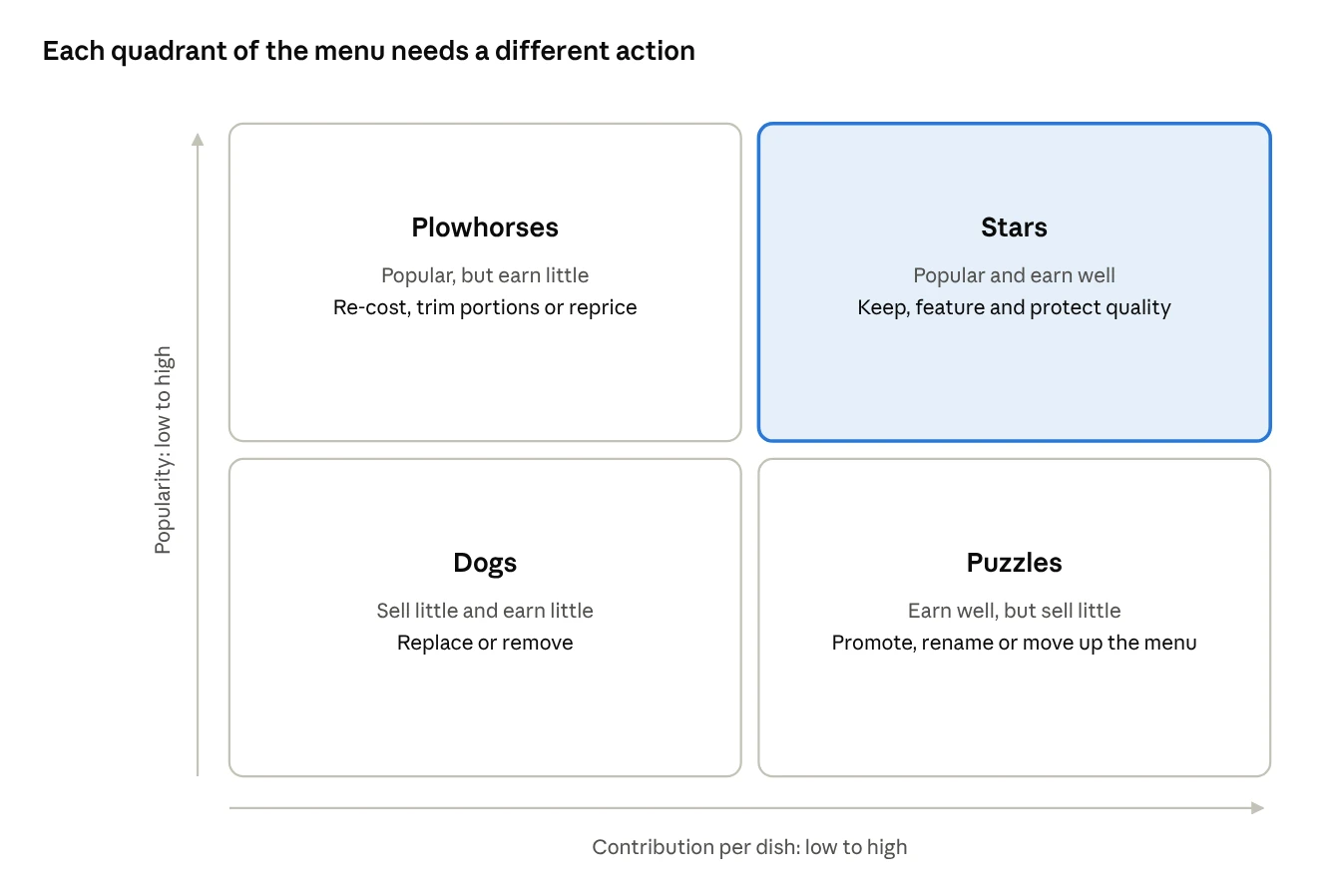
To place a dish, use a month of POS sales:
- Popularity: a dish is popular if its share of items sold is at least 70% of an equal share. With 20 dishes, an equal share is 5%, so the line sits at 3.5%.
- Contribution: a dish is high-contribution if its contribution is above the menu's average contribution per dish sold.
Review the grid every quarter, and again whenever a major supplier price changes. Dishes move between groups as costs and tastes change.
How should you price dishes for delivery apps?
Keep a separate delivery price list. Commission, packaging and promotions come out of every app order, so the dine-in price earns much less when the same dish is delivered.
Price each delivery dish for a contribution you choose: add the target contribution, plate cost and packaging, then divide by one minus the commission rate. Our guide to delivery app commissions explains the method and every deduction in full. For the chicken bowl, with plate cost AED 7.38, packaging AED 1.20 and an illustrative 25% commission:
| Target contribution | Delivery price before VAT | Menu price with 5% VAT |
|---|---|---|
| Same as dine-in, AED 17.38 | (17.38 + 7.38 + 1.20) ÷ 0.75 = AED 34.61 | AED 36.34, so AED 37 |
| AED 14.00 | (14.00 + 7.38 + 1.20) ÷ 0.75 = AED 30.11 | AED 31.61, so AED 32 |
Round delivery prices up, not to the nearest dirham. At AED 36 the bowl would earn AED 17.13 after commission and packaging, below its dine-in contribution of AED 17.38; at AED 37 it earns AED 17.85.
Where do restaurants get menu pricing wrong?
In HYP's work with restaurant groups, the price formula is rarely the problem. The inputs are: recipe costs that were right once and never updated, and margins calculated on prices that include VAT.
| What we see | Effect | The fix |
|---|---|---|
| Recipe costs set at opening and never updated | Food cost creeps up unnoticed | Link recipes to the latest purchase prices |
| Food cost % calculated on VAT-inclusive prices | Margins look better than they are | Always divide by the price before VAT |
| Yields taken from supplier sheets | Plate costs understated | Weigh your own yields for the top 20 ingredients |
| Same price on delivery apps as in the restaurant | Delivery orders earn far less | Keep a separate delivery price list |
| Prices raised across the board | Popular dishes lose volume | Reprice dish by dish using the menu engineering grid |
The most valuable change is the first. When a supplier invoice changes the price of chicken, every dish that uses chicken should show its new plate cost the same day.